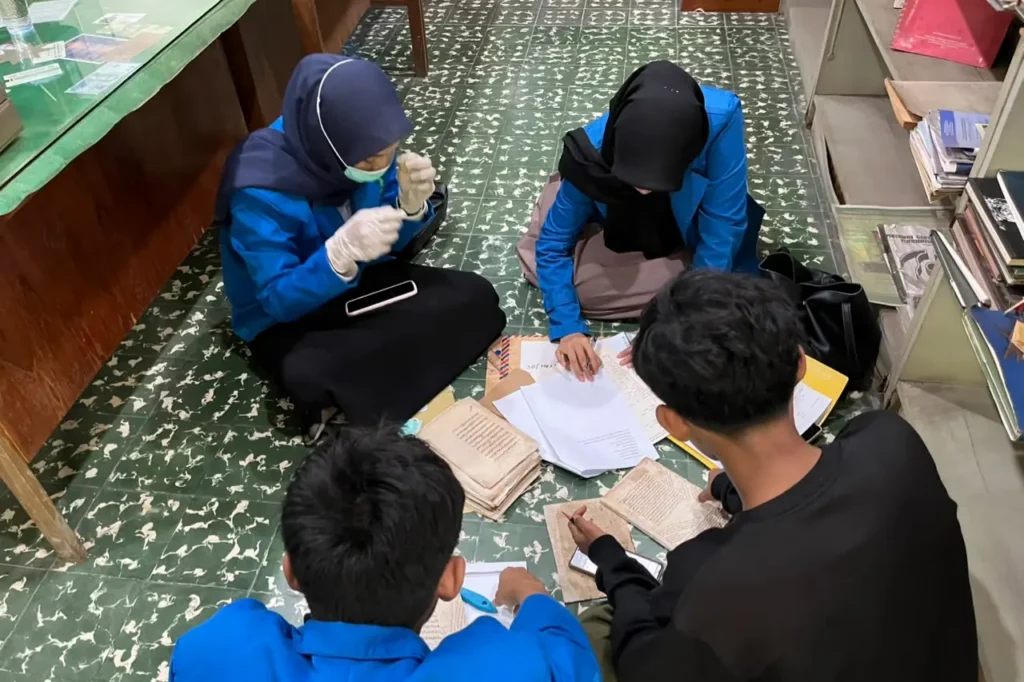
Aceh – Indonesia, A total of 50 students from the Arabic Language and Literature Study Program at the Faculty of Adab and Humanities, UIN Ar-Raniry, conducted a Philology practicum by examining ancient manuscripts collected at the Ali Hasjmy Museum in Geuceu Iniem, Banda Aceh, on Saturday, October 3, 2026.
The practicum is part of the Philology course curriculum, providing Arabic Language and Literature students from UIN Ar-Raniry the opportunity to engage directly with manuscripts as primary research objects.
Philology course lecturer, Nurdin AR MHum, stated that students of Arabic Language and Literature must possess the ability to read and analyze various types of texts, including those found in manuscripts.
“Future Arabic Literature graduates should be capable of analyzing texts, whether literary texts, Islamic religious texts, or linguistic texts preserved in manuscripts,” Nurdin said.
According to Nurdin, this skill is essential because students in this discipline will continuously work with texts. “Because text is the content of the manuscript, and the manuscript is the medium for the text,” he explained.
He expressed hope that students would not only master modern text analysis but also understand and study ancient texts preserved within manuscripts.
“In addition to analyzing modern texts, they should also be able to examine ancient texts found in manuscripts,” Nurdin added.
Following their observation of the manuscripts, students were asked to prepare a report based on the data recorded in their manuscript description forms.
Secretary of the Arabic Language and Literature Study Program at UIN Ar-Raniry, Chairunnisa Ahsana AS MHum, stated that the report is structured in the form of a Philology practicum paper.
“Students are required to write a report based on the manuscript description forms they filled out, which will then be compiled into a philology practicum paper,” Chairunnisa said.
According to Chairunnisa, this step is an integral part of the learning process to help students systematically document their observational findings from the manuscripts.
The practicum at the Ali Hasjmy Museum offered students hands-on experience in identifying manuscripts as subjects of Philology research.
“Learning does not only take place in the classroom, but also through direct observation of the manuscripts that serve as primary research sources,” Chairunnisa noted.
The activity was also attended by the Head of the Arabic Language and Literature Study Program, Sumardi MA, alongside several lecturers and Philology course instructors.