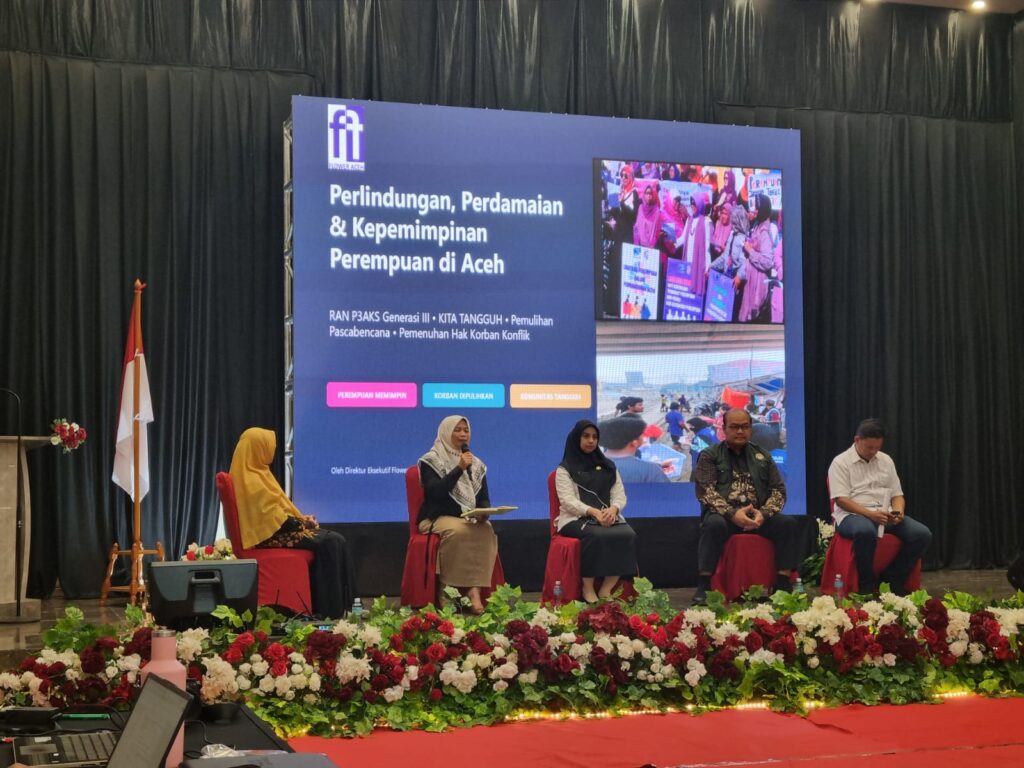
Aceh – Indonesia, Banda Aceh (Waspada Aceh) – Director of Flower Aceh, Riswati, highlighted the lack of women’s involvement in strategic decision-making, despite their major roles in conflict resolution and disaster management in Aceh.
According to Riswati, women have been the driving force at the community level, organizing relief, managing public kitchens, and assisting in evacuation efforts during disasters. However, these contributions have not translated into equal representation in strategic forums.
Riswati delivered these remarks during the Policy Dialogue on Women’s Leadership for Peace, Humanitarian Action, and Resilient Aceh at Orion Hall, Aceh Besar, Wednesday (9/30/2026).
The event also featured a screening of the documentary film Inong Peudame – Together, We Were Brave, produced by UN Women Indonesia, Aman Indonesia, alongside several women peacebuilder organizations.
Riswati, who is also one of the 12 contributors to the Inong Peudame documentary, stated that women’s leadership has actually grown strong at the community level.
“Women led the process. Their contributions were massive during the conflict. At flood sites, women organized public kitchens, managed evacuations, provided food, and more,” said Riswati.
However, when the response moves to the planning and policymaking stages, women are often left behind.
“In the subsequent steps, they are left out of strategic meetings and formal discussions. That is the challenge: women’s leadership thrives in the community, but institutional support remains weak,” she added.
Victim Recovery Remains Incomplete
In addition to leadership issues, Riswati emphasized the need to accelerate the fulfillment of rights for women affected by conflict, disasters, and gender-based violence.
She noted that a portion of conflict victims in Aceh have not fully received their recovery rights or restored their pre-conflict livelihoods.
Similar attention must be directed toward victims of disasters and gender-based violence.
“Therefore, there is an urgent need to accelerate the fulfillment of rights for victims of disasters, conflicts, and gender-based violence,” she said.
Riswati views these issues as rooted in ongoing gender inequality, ranging from discrimination, stereotypes, double burdens, to violence against women.
She added that while Aceh possesses several policy instruments to strengthen women’s participation and protection, implementation still faces hurdles, particularly regarding governance, human resources, and budget allocation.
“Our challenge lies in the implementation gap. The supporting system to execute and ensure realization still faces obstacles, from governance and human resources to funding,” she explained.
She also pointed out that gender-responsive budgeting in Aceh, according to Flower Aceh’s records up to 2025, remains around 12 percent.
She stressed that budgetary support must be increased so that women’s protection and empowerment policies can effectively address community needs.
“And that is certainly still minimal given the situation in Aceh. It requires an increase and adequate budget allocations,” she said.
Pushing Policies Down to the Village Level
Riswati also urged that national policies related to women, peace, and security be immediately implemented in Aceh down to the village level.
She cautioned that policies restricted to the central or provincial government levels risk failing to resolve the challenges faced by women at the grass-root level.
“Past experiences show that policies often stay at the top and fail to reach villages. We hope to localize these important policies down to the village level and oversee them,” she stated.
She hopes Aceh can serve as a role model in integrating conflict management, disaster response, and social issues while ensuring the fulfillment of women’s rights and participation.
“We are talking about handling conflicts and disasters, and how to build a resilient and safe Aceh by integrating all national and local instruments,” Riswati said.
She added that strengthening women’s leadership requires a sustainable ecosystem, stretching from the grassroots level to policymakers.
“It is about how we continuously empower ourselves and guarantee an ecosystem that supports women’s leadership, from the grassroots to the executive level,” she concluded. (*)