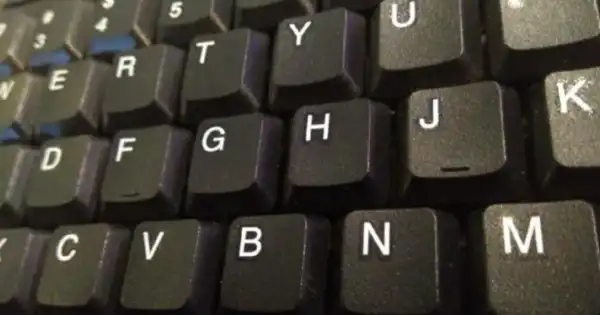
Aceh – Indonesia, Have you ever wondered why the letters on computer and smartphone keyboards are not arranged alphabetically, starting with A, B, C, and so on? The answer traces back to a journalist from Milwaukee, United States, named Christopher Latham Sholes.
In the 1860s, Sholes became interested in creating a typewriter capable of printing letters after reading an article in Scientific American about an early printing machine. Together with Samuel W. Soule and Carlos Glidden, he subsequently developed the device.
The process was far from easy. Sholes’ early prototype was massive, resembling a piano, and lacked a complete set of letters and numbers. Several components failed to function properly, causing the machine to jam frequently.
Sholes then had to rearrange the letters continuously until he eventually came up with the layout now known as QWERTY, named after the first six letters on the top letter row of the keyboard.
Citing Smithsonian, Sholes designed the QWERTY layout so that the typebars connecting the keys to the letter plates would not clash into each other when neighboring letters were pressed in rapid succession. Consequently, the typewriter operated smoothly without jamming, unlike non-QWERTY arrangements.
Additionally, the arrangement of the letters was based on the frequency of letter occurrences in English words. For example, the “E” and “R” keys were placed next to each other because the combination “ER” is widely used in the English language.
After numerous trials, Sholes finally patented the machine on June 23, 1868. Two years later, Sholes and his associates reached a manufacturing agreement with Remington. The arms manufacturer began selling the typewriter for $125 in 1874.
This marked the beginning of QWERTY’s widespread adoption. According to History, by 1891, Remington claimed that over 100,000 QWERTY-based typewriters were in use across the United States. Its growing popularity eventually led QWERTY to be adopted as an international standard.
QWERTY’s dominance was also reportedly reinforced by Remington’s business strategy. The company provided typing training courses. Typists who grew accustomed to Remington machines prompted their employers to purchase typewriters featuring the exact same layout. From that point on, the momentum of the QWERTY format became unstoppable.
As technology evolved, the QWERTY layout was not only utilized in typewriters, but is now adopted across all computer keyboards and smartphones.