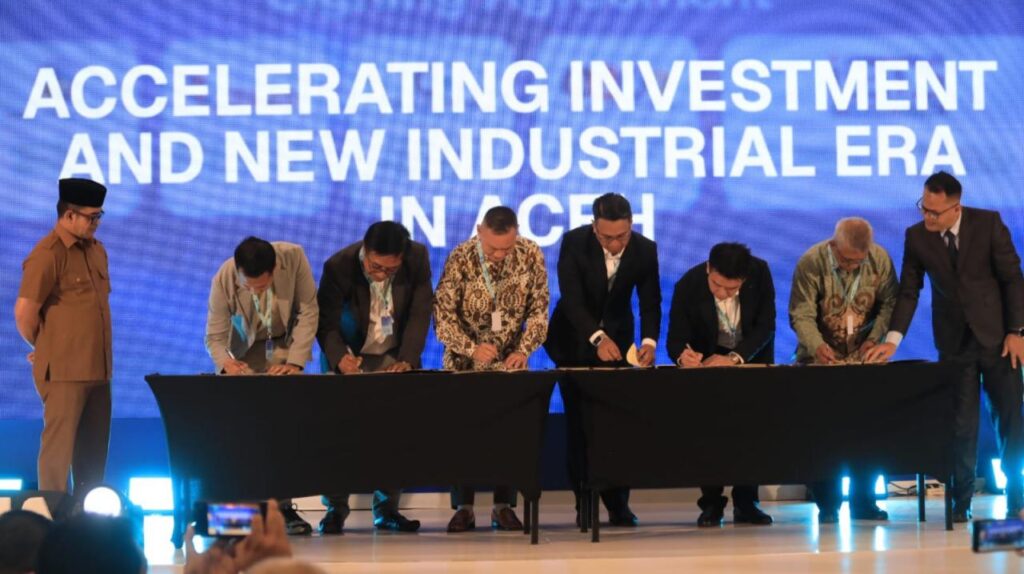
Aceh – Indonesia, The Aceh Provincial Government is shifting its economic development strategy from relying on raw commodity exports toward downstream processing and industrialization. Through the Aceh Economic Development Forum (AEDF) 2026, the government and business leaders have begun preparing an investment and industrial development roadmap for the next 10 to 20 years.
This initiative is considered crucial to ensure that Aceh’s abundant natural resources generate added value, create jobs, and foster prosperity for the local community.
The Acting Regional Secretary of Aceh, Taufik, highlighted this strategy during the AEDF 2026, organized by PT Pembangunan Aceh (PEMA) Perseroda in Banda Aceh on Tuesday, October 6, 2026. The forum carried the theme “Accelerating Investment and New Industrial Era in Aceh.”
Taufik stated that Aceh possesses vast potential in agriculture, plantations, marine resources, energy, tourism, and various flagship commodities. However, he emphasized that these resources must be managed professionally and sustainably to become a true driver of the regional economy.
“We must not allow Aceh’s resources to leave in raw form while the added value and employment opportunities are created elsewhere,” he remarked.
According to Taufik, a greater share of agriculture, plantation, fishery, energy, and other resources should be processed directly in Aceh so that local communities reap larger economic benefits.
He expressed hope that the AEDF would extend beyond a platform for exchanging ideas to deliver a concrete roadmap, clear investment opportunities, regulatory certainty, streamlined licensing, infrastructure readiness, and robust collaboration among the government, business sector, academia, banking institutions, and the public.
The President Director of PT PEMA, Faisal Ilyas, noted that despite Aceh’s rich resource potential, it has not yet fully yielded optimal added value for the region.
“We have vast oceanic waters, yet external parties enjoy the added value of our marine wealth. We possess agricultural and plantation commodities, but we continue to sell raw products,” Faisal said.
He added that Aceh’s main challenge is transforming this raw potential into value-added economic growth through targeted investment and industrial development.
“Through this forum, we will construct a roadmap outlining our strategic direction for the next 10 to 20 years,” he stated.
Faisal underscored PEMA’s major responsibility as an instrument for regional economic development. Accumulatively, PEMA has contributed Rp128 billion in dividends to the Aceh Provincial Government.
Moving forward, PEMA aims to boost its contribution to Aceh’s local revenue (PAD) amidst regional fiscal challenges and reduced budget transfers from the central government.
Six Strategic Agreements Signed
In addition to panel discussions, AEDF 2026 served as a milestone for the signing of several investment and industrial development agreements.
The first partnership was forged with Tigallapan Investama for a joint study on renewable energy development potential.
Furthermore, a strategic agreement was established with Kedah Agro Ausin Berhad, covering agro-industry development, trade, agrotourism, logistics, technology, livestock, and human resource development.
Citaglobal also signed on for a joint study focusing on sustainable energy and green fuel development opportunities.
Another agreement was signed with PT Banda Sentra Nasional (BSNS) to build telecommunications infrastructure across Aceh.
Meanwhile, cooperation with PT Indo Surya Galvalume (ISG) marked both a Memorandum of Understanding (MoU) signing and the soft launching of a lightweight steel plant, alongside an MoU and soft launch for hebel and precast brick tenants.
This series of agreements represents a coordinated effort to usher Aceh into a new era of industrialization by maximizing regional resources and attracting investments that deliver concrete added value to the public.[r]