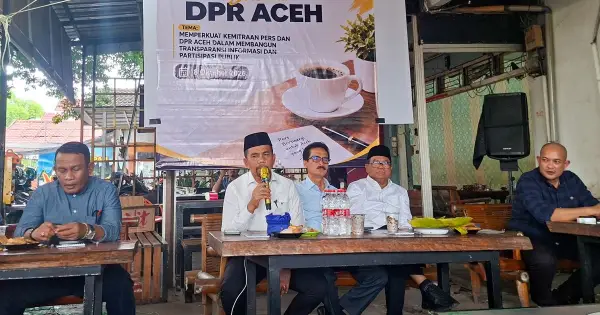
Aceh – Indonesia, The Aceh House of Representatives (DPRA) has highlighted the potential for budget overlap in the Aceh Health Insurance (JKA) program due to issues with beneficiary databases. This situation risks causing Aceh’s healthcare budget to be paid out twice for the same individuals.
DPRA First Deputy Speaker, Saifuddin Muhammad, stated that there is still a potential for residents to receive JKA coverage despite already being covered under the National Health Insurance (JKN) program or corporate BPJS Kesehatan plans.
“Regarding overlapping coverage and double payments, we have long raised this issue with the relevant technical agencies in the health sector,” Saifuddin said during a discussion titled ‘Ngopi Sore Bersama DPRA’ at the Sekber Jurnalis in Banda Aceh on Thursday, October 8, 2026.
He emphasized that the issue needs immediate verification by cross-referencing JKA beneficiary data with data from other health insurance programs.
Saifuddin noted that one critical area requiring examination is JKA recipients who are also enrolled in the JKN program based on deciles 1 through 4.
“We will attempt to re-verify this, cross-checking company data against decile community data,” he said.
In addition to recipients registered under the JKN program, some corporate employees in Aceh are already covered by BPJS Kesehatan yet remain at risk of being billed under the JKA scheme.
According to him, this situation must be rectified to prevent the Aceh Provincial Government from spending funds on individuals who already have alternative healthcare coverage.
Saifuddin assessed that the root cause lies not only within the health sector but is tied to the quality of the government’s overall database.
“The core of our issue right now, as I see it, isn’t just with the Aceh Provincial Government, but also with municipal and regency governments—it’s a fundamental issue with our database,” Saifuddin stated.
The DPRA First Deputy Speaker remarked that current government data is inadequate for serving as a foundation to determine beneficiaries for various public assistance programs and services.
“Our database is simply not ready; it’s flawed. This is what we are pushing for—the government must focus on database reform,” Saifuddin asserted.
He added that improving the database is necessary not only for the JKA program but also for various other government initiatives.
He cited the low-income housing program as an example that similarly requires accurate beneficiary data to ensure aid is targeted properly and free from duplication.
“Databases aren’t just a health sector issue; other matters rely on them as well. For instance, an issue I repeatedly bring up is low-income housing. That also requires concrete data,” he said.
The DPRA is urging the Aceh Provincial Government to update and synchronize beneficiary data with various available data sources.
Saifuddin said his party would continue to monitor the process to ensure the JKA program targets individuals who do not yet have health coverage from other programs.
“Ultimately, our goal is to ensure that all Aceh residents not covered by other insurance plans can be accommodated by JKA, preventing obstacles for the public. That is what we want to achieve,” he said.
He reiterated that database improvement is crucial for future budget planning, particularly to prevent double payments and to ensure regional funds are used according to public needs.***