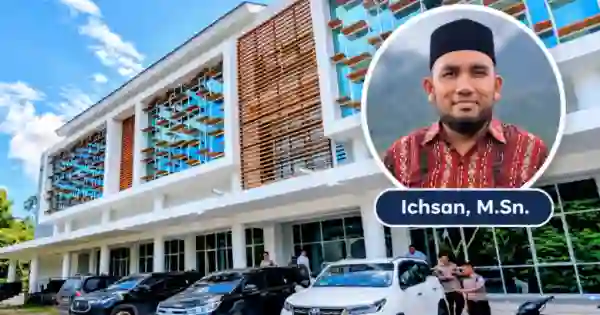
Aceh – Indonesia, Tomorrow, ISBI Aceh enters its 12th year. It seems this campus is currently in a different phase. ISBI Aceh is no longer at the stage of convincing the public that an arts higher education institution is necessary in Aceh. Its presence has become an integral part of Aceh’s higher education and cultural landscape.
Established on October 6, 2014, based on Presidential Regulation Number 126 of 2014, ISBI Aceh is the sole Arts and Cultural Higher Education Institution in Aceh. A twelve-year journey is certainly not a long time for a university. Nevertheless, this campus has experienced significant development in facilities and infrastructure. Student enrollment has also shown steady growth.
These changes are not only visible in figures and buildings. The academic culture and institutional life on campus have also shifted. ISBI Aceh, which was previously still finding its identity, is now beginning to possess the institutional capital to determine a farther direction. Therefore, the success over the first 12 years deserves appreciation. These achievements place ISBI Aceh before new demands. Now that the foundation has been laid, what matters most is what will be built upon it.
This line of thought is particularly relevant as ISBI Aceh undergoes a leadership transition. The election process for the 2026-2030 rectorate period has taken place, narrowing four initial candidates down to three. Whoever receives the mandate will take over ISBI Aceh under conditions vastly different from its early founding days. Thus, the upcoming leadership should be understood not merely as an administrative succession, but as an opportunity to shape a new chapter in the institution’s journey.
As a developing region, Aceh possesses an immense wealth of culture. Performing arts, crafts, traditional architecture, ornaments, manuscripts, language, oral traditions, music, history, cuisine, and various local knowledge systems represent a wealth of knowledge that has not yet been fully explored in depth. Some even face challenges regarding documentation and generational continuity.
ISBI Aceh should swiftly take a strategic position in this domain. The campus must not function merely as a place to teach culture, but as a hub for producing knowledge about Acehnese culture. Culture cannot simply be showcased in festivals or presented in ceremonial events. It must be researched, documented, developed, critically analyzed, and situated within the context of contemporary community life.
Therefore, a viable concept to develop is turning Aceh into an open laboratory for ISBI. Dance students, for instance, should not only master techniques and dance repertoires, but also study the society, history, social environment, and cultural shifts that gave birth to those arts. Craft students should not stop at producing goods, but develop new materials, designs, technologies, and economic models rooted in traditional knowledge. Design students can assist communities in developing visual identities and packaging for cultural products. Fine arts students can interpret environmental and social changes through artistic practice. The same applies to all other students at ISBI Aceh.
In this way, the campus and the community will not stand as two separate spaces. The public becomes part of the educational and research process, while the campus provides knowledge and innovation that can be reintegrated into society.
Such a model will also give ISBI a clearer academic identity. In my view, at 12 years old, ISBI Aceh does not need to compete with arts institutes in Yogyakarta, Surakarta, Bali, or other regions by imitating them. Instead, ISBI needs to discover the unique strengths that can only belong to an arts higher education institution growing in Aceh.
There is another matter that has been a subject of serious thought in recent days, specifically regarding internationalization. This term is often used in higher education, yet it frequently stops at international seminars, student exchanges, or formal partnerships with foreign universities.
I believe that for ISBI Aceh, internationalization should be built upon local strengths. For example, the campus could establish international artist residency programs, inviting artists and researchers from various countries to live and work in Aceh for specific periods. Rather than serving merely as seminar speakers, they would engage in collaborative research and artistic creation alongside students.
ISBI could also set up international collaborative studios bringing together Acehnese students and students from arts universities in Asia and beyond. These projects could address issues originating in Aceh, examined through cross-national perspectives.
At the same time, ISBI needs to build a digital documentation and archive center for Acehnese culture. Digital technology and artificial intelligence can be utilized for archiving, cataloging, mapping, visualization, and cultural knowledge development, while remaining mindful of community rights and the original context of the knowledge.
Consequently, internationalization does not mean abandoning Acehnese identity. On the contrary, the stronger its local foundation, the clearer its contributions will be to the world.
Another unavoidable challenge is technological advancement. Artificial intelligence, the creative economy, gaming industries, animation, film, digital design, performance technology, and various new creative formats will reshape the way artists work. Arts universities cannot rely solely on preserving conventional skills. Students must grasp technology without losing the capacity to interpret cultural contexts.
This is where ISBI can build a new competitive edge. Traditional arts and technology do not have to be positioned as opposing forces. Both can intersect to generate new forms while opening wider markets and spaces for creative expression.
ISBI Aceh requires a roadmap that transcends a single leadership term. If the institution’s vision changes every time a new rector takes office, the campus will exhaust its energy adapting to new agendas. Instead, ISBI must maintain a long-term agenda containing measurable targets, the strengthening of Acehnese arts and cultural research, cultural archive digitization, enhanced quality of publications and artistic works, creative industry development, international networking, residency programs, alumni empowerment, and direct contributions to society.
With twelve years behind ISBI Aceh, the foundational phase is complete. The next phase must serve as a period for building reputation, producing knowledge, and expanding influence.
Aceh requires an arts university that does not merely produce graduates, but also generates ideas; one that does not just put on performances, but creates knowledge; and one that does not simply preserve culture, but develops it to meet the future.
It is precisely at this juncture that ISBI Aceh holds an opportunity unavailable to many other institutions. It is situated in Aceh, a region with a long history as a crossroads of diverse cultures and civilizations. ISBI can leverage this geographic and cultural position as an academic strength. Jantho need not remain on the periphery of Indonesia’s artistic centers; it can be developed into a new focal point on the global map of education and culture.(rao)