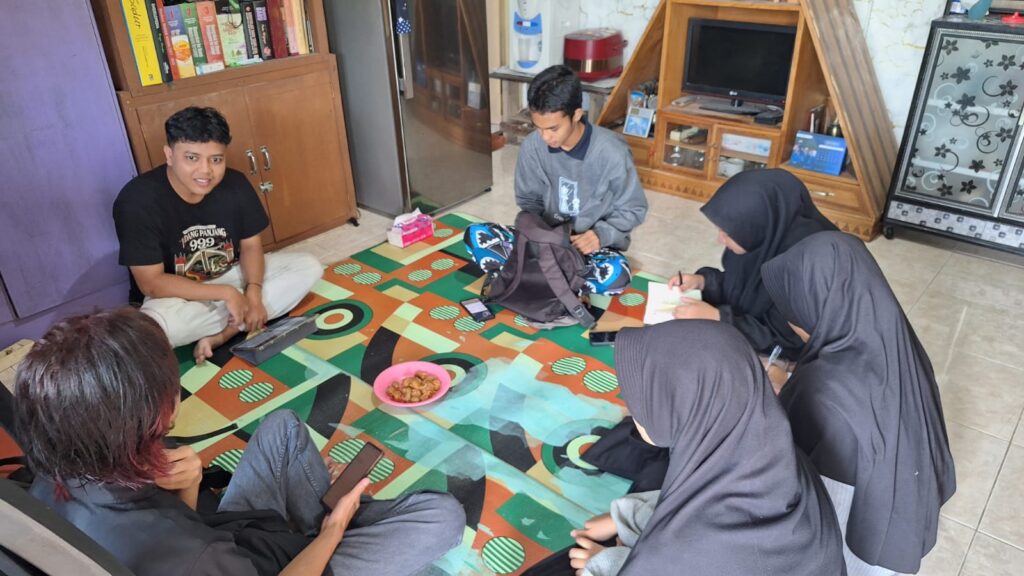
Aceh – Indonesia, Padang Panjang,- The Kuflet art community discussed the “Basics of Editing” in its routine discussion session on Saturday (03/10/26), featuring speaker Nofal Dwi Saputra, as presented by moderator Yasmin.
Nofal Dwi Saputra, the speaker who also serves as the Daily Chair of Kuflet, explained that film editing is the process of selecting, cutting, and joining shots from the shoot into a narrative flow. He added that video files from the shoot should be backed up in at least two folders and organized by scene, shot, and take.
Nofal added that this organization helps editors carry out their tasks more efficiently. Regarding the software and hardware used for editing, options include the CapCut application and laptops priced around 10 million IDR or above to ensure smooth performance. However, he noted that it ultimately depends on the editor’s comfort and the film format.
Explaining the editor’s workflow, Nofal stated that the editor manages raw footage from the shoot, selects, and joins them into a story. The initial result is called a rough cut. Revisions made by the director to the rough cut lead to Rough Cut 2 and so on until reaching the Picture Lock, which is the final locked edit. He also explained various cutting techniques—such as Continuity Cut, Jump Cut, Match Cut, Cross Cut, J Cut, and L Cut—along with transitions like Cut, Fade In, Fade Out, Dissolve, and Wipe, each serving a specific function.
Ferli, a member of the Kuflet art community, asked about the functions of transitions and how aspect ratios align with film distribution platforms.
In response, Nofal explained that while dissolve often conveys tension, cuts are also effective for creating suspense. Every transition serves a specific purpose tailored to the script. Regarding aspect ratios and distribution platforms, filmmakers must determine their distribution targets before making the film.
Another discussion participant, Fitri, asked whether visual planning is necessary before shooting.
Nofal explained that during pre-production, a storyboard is created to visualize the narrative. He concluded that an editor acts like a second director, as they shape the final flow of the story. (*)