Aceh – Indonesia, THIS is the fourth piece in the Conversations with Books series. The previous three conversations took me on a walk into the past. I conversed with Niccolò Machiavelli’s The Prince about power, with Snouck Hurgronje’s De Atjehers about Aceh and colonialism, and then with Tan Malaka’s Madilog about reason, independence, and modernity. Those books were born from a bygone era, though the questions they left behind turned out not to grow old with time.
This time, I am changing direction.
I chose a book that speaks of something unfolding right before our eyes. About a patch of earth called Iran, an ancient land that once again finds itself at the center of the world’s geopolitical vortex. Nukes, missiles, Israel, America, the Strait of Hormuz, oil, sanctions, Russia, and China ensure Iran remains constantly present in international conversations.
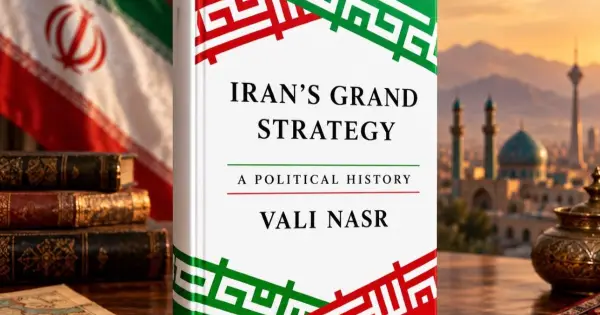
That book is Iran’s Grand Strategy: A Political History, by Vali Nasr.
Published in 2025, the book sees Nasr doing more than merely recounting what Iran does. He attempts to answer a far more difficult question: why does Iran act like Iran? Is its behavior primarily driven by the Ayatollahs, or behind them, is the strategic memory of a much older land named Persia still at work?
Before questioning his book, it feels necessary for us to get to know the person who wrote it.
A child of a lost Iran
Vali Nasr was born in Tehran in 1960. He grew up in a highly unusual Iranian intellectual family. His father, Seyyed Hossein Nasr, is a prominent philosopher and Islamic scholar who once led Aryamehr University of Technology—now Sharif University of Technology—and was quite close to the Iranian government circles prior to the revolution. Vali Nasr’s grandfather was once the royal family’s physician.
The home where Vali grew up was therefore not just that of a typical middle-class Iranian family. Within it resided religion, philosophy, Persian tradition, modern education, and encounters with the West. His father was known for bringing a reading of Islam deeply rooted in spirituality and intellectual tradition, something vastly different from the face of revolutionary political Islam that later took over Iran.
At around age 16, Vali was sent to school in England.
Then history arrived.
The 1979 Revolution toppled Shah Mohammad Reza Pahlavi. The Islamic Republic was born. For millions of Iranians, it was a change of regime. For the Nasr family, it also signaled the collapse of a lifestyle.
His family left Iran.
Nasr later described this experience as exile. In an interview, he even noted that in today’s terms, his family might be called refugees. Their family home was looted and subsequently sold. Several of their relatives and friends met far worse fates. The revolution did not merely replace a government; for a teenager named Vali Nasr, it altered the trajectory of his life.
Yet there is something intriguing.
Nasr left Iran, but Iran seemingly never truly left Nasr.
Nearly half a century later, he still speaks of losing his homeland as a heavy burden. In a 2026 interview, Nasr spoke of his attachment to his birthplace, identity, history, and the people left behind. The suffering of Iran, he remarked, is something he still feels acutely.
That imprint is also visible in how Nasr discusses Shiism.
To him, Shiism does not stop with the Ayatollahs, religious law, or the Islamic Republic. When discussing Karbala and Imam Hussein, for instance, Nasr observes a deep emotional connection among the Iranian populace. Interestingly, according to him, such feelings can endure even among Iranian families with thoroughly modern or secular lifestyles.
This means religion here functions as culture and memory as well.
Then there is a small detail in Nasr’s personal life that I find particularly fascinating.
After growing up and building almost his entire professional life in the West, he married Darya Ahyaie, a woman who also shares Iranian roots.
Of course, one shouldn’t interpret the choice of a spouse as a political statement—that would be reaching too far. But in an intellectual biography, small details sometimes help us see things that do not appear in lists of job titles and academic degrees.
Iran, for Nasr, is evidently not merely a subject of research.
It is homeland, family, tradition, language, religion, culture, and memory.
Iran at home, America in the study
His subsequent journey took Nasr deeper into the American world. He studied at Tufts University and the Fletcher School, pursuing academic depth. He wrote on political Islam, Shiism, democracy, the state, and the Middle East. His works include The Shia Revival, Democracy in Iran, The Dispensable Nation, and subsequently Iran’s Grand Strategy.
Yet Nasr is not a professor who knows Washington solely through books.
From 2009 to 2011, he served as a senior advisor to Richard Holbrooke, the U.S. special representative for Afghanistan and Pakistan. He later served as Dean of the Johns Hopkins School of Advanced International Studies (SAIS) from 2012 to 2019. Today, he is the Majid Khadduri Professor of International Affairs and Middle East Studies at SAIS.
Thus, a rather rare intellectual positioning was formed.
Nasr knows Iran from within its cultural memory, yet examines it through the lens of American political science. He understands Persia and Shiism, while concurrently speaking Washington’s language of national security, deterrence, balance of power, sanctions, and nuclear proliferation.
One foot stands in Iranian memory; the other rests in America’s strategic arena.
This is where I wish to begin my conversation with Nasr.
Professor Nasr, which Iran are you actually writing about? The Islamic Republic born in 1979, or a nation vastly older than its revolution?
The state behind the revolution
For decades, we have often known Iran through images that almost automatically pop up at the mention of its name: Ayatollah Khomeini, the U.S. Embassy hostage crisis, the Revolutionary Guard, Hezbollah, ballistic missiles, the nuclear program, and chants of “Death to America.”
All of these are real. The ideology of the Islamic Republic is no mere decoration.
Yet Nasr contends: that is not enough.
According to the core thesis of his book, Iran’s foreign policy cannot be explained simply as a product of theocracy or a zeal for exporting revolution. Beneath that layer operate interests far older and very common for any state: security, sovereignty, independence, and the desire to preserve Iran’s standing in the regional order.
There is one word that keeps recurring.
Independence.
Nasr points out that when leaders of the Islamic Republic speak of their achievements, they do not merely claim to have made Iran more Islamic. They also boast that Iran has become more independent.
That single word alters how we read the country.
Because once independence is factored in, we no longer see merely a regime born in 1979. Behind it begins to emerge Persia, empires, invasions, Russian and British rivalries, oil, foreign intervention, the Shah, revolution, the war with Iraq, sanctions, and American pressure.
Imagine an old house that outsiders have entered several times. Its occupants have changed; its furnishings have shifted; their beliefs have transformed too. Yet the house’s memory of who once broke through its door does not simply vanish.
Iran, in Nasr’s reading, possesses that kind of strategic memory.
A revolution can change who rules the house. A revolution cannot change geography.
Then came the Iran-Iraq War from 1980 to 1988.
Saddam Hussein attacked when the Islamic Republic was still in its infancy. Eight years of war helped shape Iran’s security perceptions. One lesson forged from that experience was as simple as it was brutal: in moments of extreme peril, Iran must be capable of defending itself.
From this realization, we begin to understand the path that ultimately led Iran to missiles, regional allied networks, deterrence, and its nuclear program.
Here, however, I would like to interrupt Nasr.
Professor, doesn’t nearly every nation claim the exact same thing?
America speaks of national security. Israel speaks of defending its existence. Saudi Arabia speaks of regional stability. Iran speaks of sovereignty and independence.
If everyone speaks in the name of security, when does defense cross over into expansion?
That question is crucial because understanding is not synonymous with justifying.
Iran can feel encircled. At the same time, other nations can feel threatened by Iran. What Tehran calls strategic depth can be viewed by its neighbors as power projection. What one side calls deterrence can be felt by the other as a threat.
This is where Nasr’s book becomes a pleasure to politely argue with.
It asks us to stop relying on answers that are too easy: Iran does this because of the Ayatollahs; Iran does that because of fanaticism; Iran does the other because it seeks to export revolution.
Nasr asks us to see the state behind the revolution.
Yet we are entitled to ask the converse question. After the world has spent so long looking at the revolution and forgetting the state, could it be that Nasr is so eager to uncover the state that he diminishes the significance of the revolution?
We do not need to answer that just yet.
For Part I merely introduces the person sitting across the table from us.
A son of Iran lost his homeland to revolution. He was subsequently shaped by American universities, entered Washington policy circles, yet continues to carry Iran within his family, traditions, intellectual labor, and memory.
Nearly half a century later, he writes a book asking the world to do something simple yet often difficult in geopolitics:
understand the adversary before explaining its actions.
Hence, Iran’s Grand Strategy is not a book that asks us to love or hate Iran. Its question is far more intriguing:
What does Iran actually want, and where does that desire stem from?
In Part II, we will open up that hood. Inside, there are the Ayatollahs and the Revolutionary Guard, missiles and nukes, Hezbollah and the Axis of Resistance, America and Israel, alongside Russia and China.
Yet perhaps, as Vali Nasr seeks to convince us, deep down in the innermost core of that engine, an old fear remains very much alive:
the fear of an ancient land that its destiny will, once again, be decided by others.***