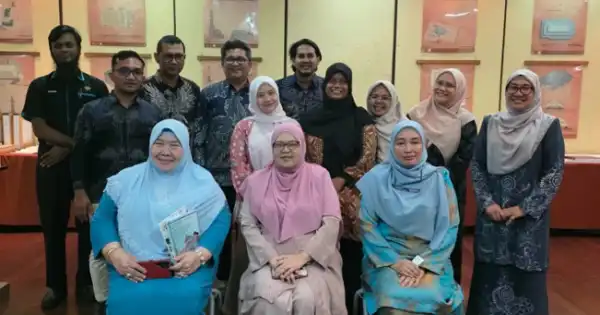
Aceh – Indonesia, Lecturers from the Faculty of Engineering at Malikussaleh University (UNIMAL) are strengthening their international academic network through a visit and exploratory partnership discussions with the International Islamic University Malaysia (IIUM).
This activity follows up on the implementation of the International Visiting Professor program in June 2026, which featured visiting lecturers, while serving as a momentum to expand academic networks by exploring collaboration with the International Islamic University Malaysia (IIUM).
The exploratory partnership aims to strengthen the implementation of the Tri Dharma of Higher Education, covering education, research, community service, scientific publications, faculty and student mobility, joint laboratory use, and human resource development. These efforts are expected to open up more space for academic collaboration and enhance the international exposure of UNIMAL’s Faculty of Engineering.
This initiative involves lecturers from three study programs in UNIMAL’s Faculty of Engineering: Architecture, Urban and Regional Planning (PWK), and Environmental Engineering. Representing the Architecture Study Program are Dr. Eng. Muhammad Iqbal, S.T., M.Sc. and Dr. Atthaillah, S.T., M.Arch.; from PWK are Qanitatul Isra Qamal, S.P.W.K., M.P.W.K. and Abdul Razak Nawaf, S.T., M.URP.; while from Environmental Engineering are Dewi Fitria Marlisa, S.T., M.T. and Rahmatun Maula, S.T., M.T.
UNIMAL-IIUM Expand Academic Network
The academic networking continued with a meeting at the Kulliyyah of Architecture and Environmental Design (KAED), IIUM, on September 24, 2026. The meeting brought together UNIMAL lecturers from the Architecture, PWK, and Environmental Engineering study programs with Dr. Noor Suzilawati Rabe and academic staff from KAED IIUM.
Discussions focused on various academic collaboration opportunities. IIUM expressed willingness to assist as editors and reviewers, invited Unimal academics to join the editorial management of the Journal of Architecture, Planning and Construction Management, and offered publication space for student studio work (across all studio levels) in the Design Ideals Journal. Other topics included cross-country research and joint publications, student exchanges, guest lectures, faculty exchanges, shared research facilities, joint international conferences, and further study options (scholarships). Publication collaboration also encompasses the involvement of IIUM academics as reviewers for UNIMAL’s Arsitekno Journal, opportunities for UNIMAL lecturers to serve as authors and reviewers for the Journal of Architecture, Planning and Construction Management, and student studio publications in the Design Ideals Journal. Furthermore, publication opportunities are open in the Planning Malaysia journal for research relevant to planning, the built environment, infrastructure, and urban design. Both institutions also explored book exchanges and academic publications to strengthen networking and knowledge sharing between UNIMAL and IIUM.
Both parties also discussed preparing a Memorandum of Understanding (MoU) as a foundation for cooperation. The signing of the MoU is planned to take place online so that the partnership can swiftly move into the implementation phase.
One topic receiving significant attention was the Urban Heat Island (UHI) phenomenon. This issue has strong potential to be developed into multidisciplinary research involving Architecture, PWK, and Environmental Engineering. Qanitatul Isra Qamal, S.P.W.K., M.P.W.K., noted that UHI presents a solid framework for a joint research agenda because it touches on various scientific disciplines.
“From an architectural perspective, we can evaluate building design, materials, orientation, and passive design strategies. From urban and regional planning, we can examine spatial patterns, density, land cover, and regional development. Meanwhile, environmental engineering allows us to assess environmental conditions and ecological factors related to urban thermal conditions,” she explained.
According to Qanitatul, this multidisciplinary approach brings together various expertise while opening up opportunities for faculty and students to engage in international research.
Representing IIUM, Dr. Noor Suzilawati Rabe warmly welcomed the collaboration opportunities, emphasizing the importance of translating institutional cooperation into direct academic activities involving lecturers and students.
Image 1. Meeting between UNIMAL lecturers and IIUM academics discussing partnership opportunities in research, scientific publications, academic mobility, and capacity building.
Support from UNIMAL’s Faculty of Engineering
The Dean of the Faculty of Engineering at UNIMAL, Dr. Muhammad Daud, S.T., M.T., expressed full support for strengthening academic ties and expanding international networks through these activities.
“We strongly support the reinforcement of cooperation in building international academic networks. Collaborations like this open broader horizons for faculty and students to learn, conduct joint research, and build academic capacity. We hope this partnership goes beyond signed documents and materializes into real activities that benefit both universities,” he stated.
The partnership with IIUM is expected to evolve into activities with measurable academic outputs, such as joint research and publications, faculty and student exchanges, guest lectures, laboratory utilization, and academic capacity building.
For UNIMAL’s Architecture Study Program, the joint UHI research collaboration with IIUM serves as an opportunity to bolster multidisciplinary research while broadening international academic connections. The participation of the PWK and Environmental Engineering programs further reinforces the potential for collaboration on building, regional, environmental, and sustainable development issues.
Through this network, UNIMAL’s Faculty of Engineering aims to expand opportunities for lecturers and students to learn, conduct research, collaborate, and produce academic works with international partners.(rao)