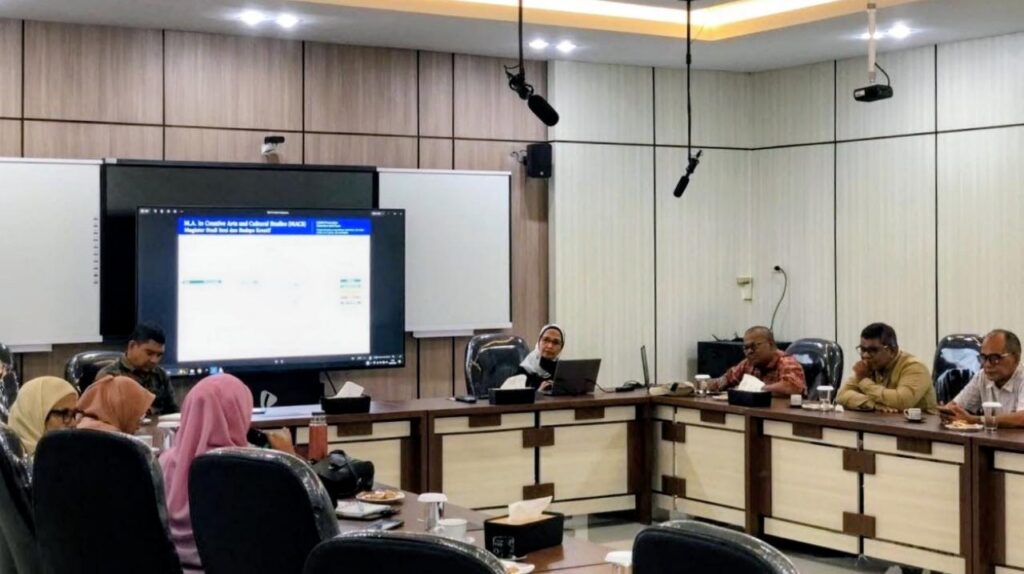
Aceh – Indonesia, The proposed Master’s Program in Creative Arts and Cultural Studies (M.A., in Creative Arts and Cultural Studies/MACS) at Syiah Kuala University (USK) has reached a new phase.
After two previous writings initiated conversations regarding this idea and documented responses, including from the youth, the Core Team presented MACS to the USK Graduate School on September 29, 2026. The audience provided an opportunity to assess how the design developed so far could be interpreted from both academic and institutional perspectives.
The Core Team was directly received by the Director of USK Graduate School, Prof. Dr. drh. Muslim Akmal, M.P., and the Vice Director for Academic Affairs, Afnan, S.Kom., MM(T)., M.Sc., Ph.D. Attending from the Core Team were Dr. Ir. Ar. Izziah, M.Sc., IAI., Dr. Ir. Ar. Elysa Wulandari, M.T., IAI., Zulfikar Taqiuddin, S.Sn., MT., Dr. Monalisa, SP., M.Si., and myself, alongside Prof. Dr. Bahrun, S.Pd., M.Pd., who was also involved in the discussion.
The meeting was open and collaborative. Following introductory remarks from the Graduate School leadership and the Core Team, I presented the MACS working document jointly developed over time. Dr. Afnan then moderated the discussion. Inquiries and feedback ranged from academic design to more concrete issues regarding human resources, homebase, curriculum, accreditation forms, facilities, funding, and official establishment procedures.
At that point, the dialogue began to carry real weight. The concept could no longer rely solely on conviction; it had to withstand scrutiny.
When Ideas Meet Reality
The document presented by the Core Team was not a final curriculum. It served as a conceptual framework to test and refine the MACS design, covering its interdisciplinary nature, fields of study, graduate profiles, the alignment of expertise with thesis topics, cross-disciplinary supervision, research and creative activity clusters, as well as the concept of Aceh Living Heritage.
Because it remains a framework, input from the audience was crucial.
Dr. Afnan emphasized the importance of precise Indonesian nomenclature to comply with Ministry of Higher Education (Dikti) regulations and the program’s academic intent. Questions regarding the homebase and the alignment of prospective faculty expertise were also addressed. Prof. Bahrun offered insights into fulfilling standard procedures and ensuring complete documentation for the accreditation forms.
For the Core Team, discussions focused on matters needing clarification, such as the formal stages of program launching, proving human resource readiness, mapping facilities and funding, and identifying areas requiring further verification.
These questions shifted the perspective on the MACS project. Interdisciplinarity could no longer simply be declared as a program identity; it must be reflected in the academic structure and demonstrated through expertise, curriculum, supervision, and governance.
Expertise Working in Synergy
MACS began to find its logic precisely when diverse expertise was brought together rather than standardized.
Dr. Izziah and Dr. Elysa bring experience intersecting with architecture, spatial dynamics, environment, locality, and culture. Dr. Monalisa holds a background in anthropology and ecolinguistics, along with research experience in Acehnese cultural practices.
These fields of expertise do not need to be forced into a single new discipline. What is required is a way to converge them around clear academic issues.
Thus, team teaching does not mean every expert must teach every course. Experts can collaborate during syllabus design, act as discussants, serve as guest lecturers, engage in research and creative production, or support thesis supervision according to their expertise and applicable regulations.
The same applies to students. The relationship between disciplinary backgrounds, thesis choices, supervisor expertise, and research or creative tracks must be designed as a unified system.
This is where the concept of interdisciplinary professionals in MACS must translate into a tangible learning experience. Every student retains depth in their core domain while gaining the ability to understand, communicate, and collaborate across other disciplines.
Two Parallel Efforts
Leaving the USK Graduate School building, the vision now demands execution.
There is a substantive-academic track that I coordinate, tasked with strengthening program identity and nomenclature, fields of study, graduate profiles, curriculum, team teaching, academic justifications, and the substantive basis for homebase requirements.
Concurrently, there is a procedural-administrative track coordinated by Mr. Zulfikar, which includes surveying prospective students, data processing, human resource and homebase mapping, accreditation forms, and institutional opening requirements.
Neither track can operate in isolation. The academic framework dictates the necessary data and evidence. Conversely, findings from human resource mapping, regulations, and administrative forms may require revisions to the academic design.
The possibility of involving adjunct faculty from other universities must also be verified against existing regulations. This highlights that preparatory work must proceed under assumptions open to verification rather than premature decisions.
Unlocking Potential
Prof. Muslim directed that the MACS proposal be finalized for processing through formal mechanisms and submitted to the relevant committee at the University Senate level. He also agreed to issue an official decree for the Ad Hoc MACS Establishment Preparation Team.
Several tasks became more defined, including fulfilling the minimum curriculum requirement of 36 credits, coordinating with the Quality Assurance System (SPM), mapping Graduate School facilities, and securing homebase requirements.
These directives do not imply that all challenges are resolved. Rather, they define a clearer boundary for the work ahead.
In follow-up discussions, an idea emerged to utilize the Blang Nangka Off-Campus Study Program (PSDKU) as a Saman laboratory for further study, exploring potential learning and research initiatives tied to living cultural practices in Aceh. This idea remains an exploratory concept, not yet an institutional decision.
Broadly speaking, MACS holds potential to connect expertise across arts, culture, humanities, technology, design, education, economics, and other fields available at USK. This platform can expand into inter-institutional learning, research, creative output, community service, innovation, entrepreneurship, and collaboration.
Aceh’s rich artistic and cultural heritage can serve as a vital source of knowledge and academic identity. However, MACS does not need to be confined to local issues. From Aceh, broader questions can be raised regarding culture, society, space, environment, technology, creativity, and social change.
All these possibilities must ultimate be proven through program quality and measurable outcomes.
The next stage is no longer about explaining why MACS matters. The task now is ensuring the idea can stand as a robust academic program—anchored by a clear curriculum, qualified faculty, verifiable homebase, valid accreditation forms, mapped facilities and funding, and accountable governance.