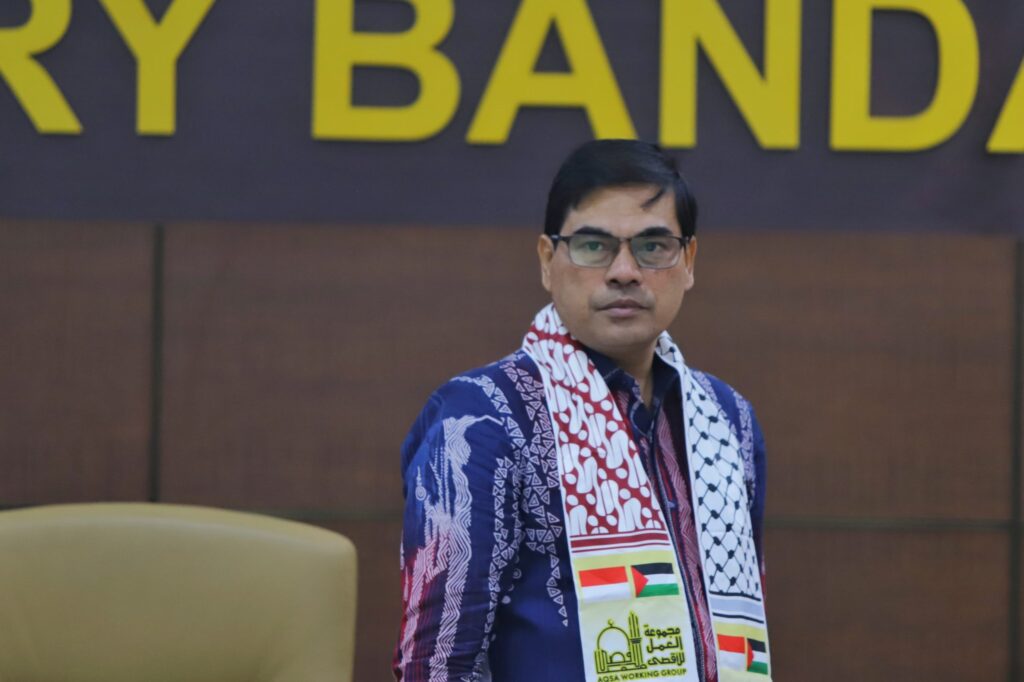
SAGOE TV — Rector of Ar-Raniry State Islamic University (UIN) Banda Aceh, Prof. Mujiburrahman, reminded that mosques should not become spaces that widen divisions among people with differing views, backgrounds, and choices. According to him, mosques must serve as places of encounter that strengthen brotherhood, dialogue, and peace.
“We should not view mosques merely as places to perform worship. A mosque must also be a place where people meet, engage in dialogue, and empower one another. Therefore, mosques should be spaces that unite the ummah, rather than creating further distance among us,” Mujiburrahman said.
He made these statements in response to the outcomes of the 2026 International Grand Imams Conference (IGIC), which took place in Jakarta on September 25–27, 2026.
The forum, which brought together grand imams, muftis, and delegates from various countries, led to the establishment of The International Assembly of Mosque Imams (IAMI). Minister of Religious Affairs and Grand Imam of Istiqlal Mosque, Prof. Nasaruddin Umar, was appointed as IAMI’s first president.
IGIC 2026 also produced the Jakarta Understanding: On Mosque Harmony, Religious Diplomacy, and Global Peace. The agreement positions imams and mosques as crucial elements in fostering harmony, religious diplomacy, and peace.
The Rector of UIN Ar-Raniry stated that differences within society are inevitable. The key challenge lies in ensuring these differences do not escalate into conflict.
“This message is deeply relevant to our current situation. Differences are something we cannot avoid. What matters is ensuring those differences do not become a source of division. This is where imams and mosques bear a great responsibility,” Mujiburrahman noted.
In his view, imams hold a strategic position due to their direct interaction with the public. Consequently, the role of an imam extends beyond leading prayers and delivering sermons.
“Therefore, I believe the role of imams today is expanding. It is no longer just about leading prayers and giving sermons, but also guiding the community through various emerging issues, including challenges in the digital space,” he said.
In the Jakarta Understanding, the grand imams called for enhanced digital literacy and a firm rejection of hoaxes and hate speech. The agreement also outlines commitments to social justice, the protection of children, women, persons with disabilities, minority and vulnerable groups, environmental sustainability, and global collaboration.
Mujiburrahman added that this message of peace carries special significance for Aceh. He emphasized that Aceh possesses valuable experience in building peace, which must be preserved and passed down to future generations.
“Aceh has history and experience in building peace. We must continuously nurture that experience. We cannot allow future generations to view peace merely as a story, without understanding how it was built and sustained,” he remarked.
He mentioned that this experience serves as social capital to strengthen the role of mosques as centers for community development and peaceful living.
Mujiburrahman, who also serves as the Chairman of ICMI Aceh, highlighted that Islamic higher education institutions can support this role through education and community outreach.
According to him, universities possess academic knowledge and tradition, while mosques maintain close ties to society’s daily life. Synergizing both can address various challenges facing the community.
“Mosques and universities must walk hand in hand. Campus institutions hold knowledge and academic tradition, while mosques are deeply connected to the everyday lives of the people. If both can synergize, we can better address many issues faced by the ummah,” Mujiburrahman stated.
He emphasized that religious values must not remain merely as discourse, but must actively manifest in daily life.
“What matters most is how religious values are truly felt in our lives. Religion must bring about peace, uphold human dignity, and enable us to live together amidst our differences,” he added.
In the Jakarta Understanding, the grand imams also reaffirmed their support for the Palestinian people’s right to self-determination, the protection of civilians, the enforcement of international law, and the realization of sustainable independence, justice, peace, and dignity for Palestine. The agreement was finalized in Jakarta on September 27, 2026.