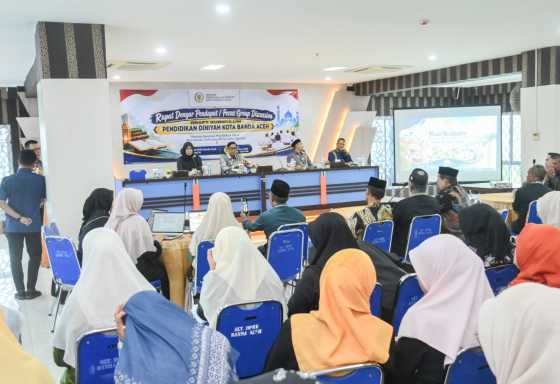
Aceh – Indonesia, Deputy Speaker of the Banda Aceh DPRK, Dr. Musriadi, S.Pd., M.Pd., has urged that the Draft Diniyah Education Curriculum for Banda Aceh City move beyond being a mere academic document to being fully implemented in schools to foster a generation with Quranic character.
Musriadi conveyed this in his remarks during the Focus Group Discussion (FGD) on the Draft Diniyah Education Curriculum for Banda Aceh City, themed “Towards a Basic Education Generation of Banda Aceh City with Quranic Character,” held at the Banda Aceh DPRK Office Hall on Thursday, October 8, 2026.
The FGD was opened by the Head of the Banda Aceh City Education and Culture Office, Sulaiman Bakri, M.Pd.
The event was attended by various stakeholders, including the Education and Culture Office, MPD, MAA, MPU, Dayah Education Office, Islamic Sharia Office, Kobar GB, PGRI, elementary and junior high school principals, as well as representatives of diniyah education teachers.
Also present was the drafting team for the Draft Diniyah Education Curriculum from UIN Ar-Raniry Banda Aceh and Syiah Kuala University (USK).
Musriadi stated that drafting the diniyah curriculum is not simply about completing a document, but concerns the future direction of education and the character of Banda Aceh’s children.
“We are not merely drafting a curriculum document. We are laying the foundation for the education and character of Banda Aceh City’s children,” Musriadi said.
According to him, Banda Aceh City Qanun No. 4 of 2020 concerning Diniyah Education must be realized through concrete implementation across educational units.
He mentioned seven fields in the curriculum—namely Quranic Literacy (BTQ), Tahfidz, Islamic Creed (Akidah), Jurisprudence (Fikih), Ethics (Akhlak), Islamic History (Tarikh), and BTAM—that must be integrated to shape student character.
“Learning the Quran must foster a love for the Quran. Learning ethics must be reflected in behavior. Learning religion must cultivate personal piety and social awareness,” he stressed.
Musriadi assessed that Islamic religious education is increasingly crucial amid technological advancements, social media, and the heavy flow of information. Diniyah education, he said, must serve as a moral compass guiding children in their behavior and decision-making.
He also emphasized the importance of teacher and school readiness in implementing the curriculum, including educator competencies, learning materials, educational facilities, and evaluation systems.
“No matter how good the curriculum is, it will not work without competent educators who also serve as role models for the students,” he stated.
Musriadi affirmed that the Banda Aceh DPRK will continue to support the strengthening of Islamic education in line with its functions and authority, including planning and budgeting aspects based on regional capacities and statutory regulations.
He expressed hope that the FGD involving the government, religious scholars, academics, professional organizations, school principals, and teachers would produce concrete recommendations to refine the draft curriculum.
“We must not let this curriculum look good only on paper. We want Islamic education to truly come alive in schools and nurture children who are faithful, knowledgeable, ethical, and grounded in Quranic character,” Musriadi concluded. []
Komentar