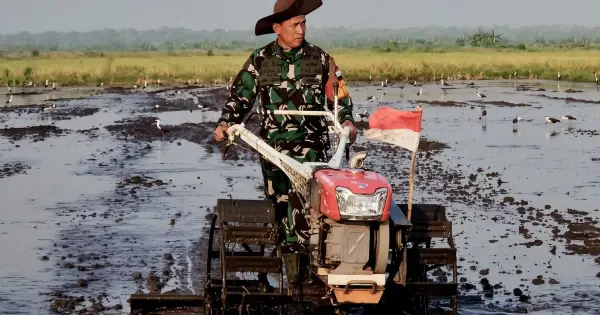
Aceh – Indonesia, “LIFE is not about how high one’s rank is, but rather how many footprints of goodness are left behind.”
That sentence seems to intertwine throughout the journey of Lt. Gen. TNI (Ret.) Dr. Ahmad Rizal Ramdhani. A military Engineer soldier forged to clear paths, build bridges, break through isolation, and restore lives—who then brought that experience to another realm of service no less decisive for the nation’s destiny: food security.
Roads, bridges, and rice may seem like three different things at first glance. Yet semiotically, all three convey the exact same message: connectivity.
Roads connect places. Bridges unite two shores. Food connects the land with life.
For an Engineer soldier, building is not merely erecting structures of concrete and steel. Building means eliminating disconnectivity. A bridge becomes meaningful not because of the length of its span, but because after it stands, human beings can reach the other side.
The same applies to food. A grain of rice gains meaning only when its long journey—from the mud of the paddy fields, the hands of farmers, the mills, warehouses, and distribution channels—ends up as a plate of warm rice for the people.
Rizal’s journey from combat boots to grains of rice has indeed been long. However, his orientation remains unchanged: opening a path for life.
From the Corps of Engineers Barracks
Born in Bandung on November 19, 1970, Rizal chose his path of service through the Military Academy, graduating in 1993. The Indonesian Army Engineer Corps became the cauldron that forged the beginning of his journey.
The Engineers are a corps prepared for warfare, yet much of their work is intimately connected to life: opening roads, constructing bridges, neutralizing landmines, repairing infrastructure, and establishing access in places that were previously cut off.
It was there that Rizal learned courage does not always mean charging forward. Sometimes courage is the ability to find a way when all paths seem closed.
Technical precision, discipline, teamwork, and the ability to make decisions under pressure subsequently became integral to his leadership style.
His career progressed from lower units until he was trusted to hold various commands, including serving as Commander of the 1st Combat Engineer Battalion/Dhira Dharma under Kodam I/Bukit Barisan in 2010–2011.
Another chapter unfolded when he was appointed to command Korem 162/Wira Bhakti in West Nusa Tenggara. In Lombok, a soldier’s knowledge directly met human suffering.
Amidst the Lombok Ruins
In August 2018, the earth of Lombok shook violently. Homes collapsed. Schools and places of worship were damaged. Roads were severed. Thousands were injured, hundreds of thousands were displaced, and hundreds lost their lives.
An earthquake always leaves two types of ruins: the visible and the invisible. The visible ones are walls, roofs, roads, and buildings. The invisible ones are the collapsed sense of safety within human hearts.
Amidst those ruins, Rizal faced one of his toughest trials. As Commander of Korem 162/Wira Bhakti, he was tasked with leading the Emergency Disaster Management Task Force for the Lombok Earthquake. Following the emergency response period, he was once again trusted to lead the Integrated Task Force for Post-Earthquake Rehabilitation and Reconstruction in NTB.
During that period, in my role as Expert Staff to the Head of BNPB, Lt. Gen. Doni Monardo, I frequently met Commander Rizal. Our interactions continued when the Covid-19 pandemic swept the globe. Two different disasters, yet presenting the same question: how quickly can the state be present when its people are at their most fragile point?
Disasters teach one simple lesson. In front of someone who has lost their home and family, military rank becomes insignificant if it is not accompanied by empathy.
Rizal chose to stay close to the citizens. Walking among the ruins, listening to the grievances of evacuees, ensuring food, clean water, and medical supplies arrived. The command post had to function, aid had to move, and life had to be gradually rekindled.
Those stories were later documented in the book “Mempolong Merenten,” which I co-authored with Roso Daras: a account of Commander Rizal’s collaboration with the Head of BNPB, Lt. Gen. Doni Monardo, in managing the rehabilitation and reconstruction of the Lombok Earthquake.
“We must all realize that natural disasters are recurring events; thus, whatever documents or records exist regarding disasters will undoubtedly be of immense benefit in the future,” stated Commander of Kodam IX/Udayana, Maj. Gen. TNI Maruli Simanjuntak, during the launch of the book “Mempolong Merenten” at Hotel Killa Senggigi, Lombok, on Wednesday, April 28, 2021.
Because after an earthquake, it is not merely walls that must be rebuilt. A sense of security must be restored to homes. The courage to move forward must be cultivated. Children must be reassured that the night does not forever mean the earth will shake again.
In NTB, the duty of an Engineer found its most human face: rebuilding hope.
“Harakiri” in Merauke
His journey then led Rizal to Merauke, Papua. If Lombok taught him to read ruins, Merauke taught him to read the land.
In that vast expanse, he confronted food security issues, agricultural development, and indigenous communities whose cultures had taken root long before the state arrived with development programs.
To indigenous communities, land is not merely a set of coordinates on a map. Land is memory. It holds ancestors, history, life, and identity itself.
Therefore, development cannot simply arrive with heavy machinery, project maps, and orders. It requires listening ears.
Rizal engaged in dialogue with customary leaders, tribal chiefs, and local residents. He understood that national programs lose their meaning if they are detached from the people living on the land where those programs are implemented. Customary land rights, traditions, and the daily lives of local communities had to be part of the conversation.
There is a small story that illustrates his way of working.
When communities accustomed to hunting were first introduced to agriculture, farming theories were not always easy to translate. Planting rice required simple language.
Thus emerged a term that sounded slightly terrifying: “harakiri.”
It was not the Japanese ritual, but an acronym: *hambur kanan, hambur kiri* (scatter right, scatter left). Seeds were scattered to the right and to the left.
It sounded humorous, but behind that lighthearted joke lay a lesson in leadership: no matter how large a policy is, it must ultimately find a language that people can understand.
For a leader is not merely someone capable of issuing instructions. A leader is someone capable of translating grand ideas into simple actions.
And seeds carry their own philosophy. A seed must be willing to be buried, appearing almost lost beneath the soil, before growing into life one day.
Return to the Lecture Hall
In the midst of his military career, Rizal harbored another passion: academic knowledge. He understood that state challenges were growing increasingly complex. Field experience is a magnificent teacher, but experience requires a conceptual framework to be translated into effective policy.
He pursued doctoral studies at the Graduate School of Universitas Indonesia in Sustainable Development, focusing on a subject that served as a bridge between his past and future: food security.
His dissertation was titled “Collaborative Governance Transformation of Sustainable Rice Post-Harvest in Indonesia using Soft System Methodology.” That analytical framework helped him view issues not as isolated parts, but as an interconnected network: farmers, markets, government, distribution, technology, bureaucracy, and society.
Perhaps the Engineer Corps had already taught him a similar logic. A bridge never stands on a single pillar. There are foundations, spans, loads, engineering, and two shores that must be connected.
Food operates the same way. Farmers cannot stand alone. Markets cannot function in isolation. Warehouses, distribution, pricing, technology, and policies are the pillars of that same bridge.
Academic research provided him with a new way to understand these relationships. That journey felt complete when he earned his doctorate while leading BULOG.
A Service Called Food Security
After decades in a military uniform, Rizal stepped into a different realm of service. There was no sound of gunfire. No landmines to neutralize. Yet there was something equally strategic: food security.
Ahmad Rizal Ramdhani assumed the responsibility of President Director of Perum BULOG starting July 3, 2025, pursuant to the Decree of the Minister of SOEs Number SK-192/MBU/07/2025.
At BULOG, he manages a delicate balance: between farmers’ unhusked rice and the price of rice on the public’s dinner tables; between national reserves and distribution; between the interests of producers and the purchasing power of consumers.
It is here that the long experience of an Engineer soldier finds a new destination. In the past, he built bridges so people could cross to the other side. Now, what must be bridged is the farmer’s paddy field and the public’s kitchen.
He oversees the absorption of harvested rice so that the hard work of farmers receives fair appreciation, while maintaining food availability and price stability to ensure rice reaches communities in need.
The work is often measured in numbers: tonnage, stock levels, absorption rates, market prices, warehouses, and distribution logistics. Yet food actually speaks a language far older than statistics.
Behind a single sack of rice is a farmer who rose before dawn, feet wading through deep mud, back scorched by the sun, navigating seasons that can be a friend or a foe. At the end of that chain is a family waiting for steaming rice in their kitchen.
Thus, a BULOG warehouse is not merely a storage facility. From a philosophical perspective, it is a space where the state shelters a nation’s sense of security. Sacks of rice represent a quiet promise that when seasons turn harsh, disasters strike, or prices fluctuate, the state still has food to place on the people’s tables.
During his fifteen months leading BULOG, several milestones marked Rizal’s tenure. Government rice reserves in 2026 reached approximately 5.36 million tons—the highest in BULOG’s history—while the target of absorbing four million tons of rice equivalent from domestic production was achieved ahead of schedule.
Rizal himself received the Indonesia Best 50 CEO Awards 2026 in the Most Popular category. Naturally, these achievements were not the work of a single individual, but the fruit of seamless orchestration between farmers, BULOG, the Ministry of Agriculture, regional governments, the Military and National Police, and various other stakeholders.
Therefore, BULOG’s accomplishments ultimately reflect the government’s success in strengthening national food reserves and supporting domestic agricultural production.
While millions of tons of stock are important, the deepest meaning lies not in full warehouses. The true measure is when a farmer’s harvest finds a buyer, the nation maintains its reserves, and rice finds its way into the homes of the people. In the language of the Engineer Corps: a bridge matters when people can safely reach the other side.
For hunger knows no rank, position, ethnicity, or religion. And a plate of rice never asks who is about to eat it.
Managing food security is one of the quietest forms of safeguarding a nation.
From Bridges to a Plate of Rice
If Ahmad Rizal Ramdhani’s journey were drawn as a single long line, the common thread would be building and connecting.
The Engineer Corps taught him to build roads and bridges. Lombok taught him to rebuild lives from ruins. Merauke taught him to align government initiatives with human lives and local culture. Academia taught him to bridge real-world experience with scientific knowledge.
BULOG provided him with a wider bridge to build: ensuring that the sweat of Indonesian farmers culminates in a plate of rice for its people.
It is in this sense that a grain of rice carries beautiful symbolism.
It bows lower as it fills. The fuller the grain, the lower the stalk bends. Nature seems to leave an enduring lesson about leadership: the greater the responsibility entrusted to someone, the more humbly they should walk.
In the end, military ranks will be retired. Leadership positions will be handed over to successors. Uniforms will be stored away. Offices will be occupied by others.
What remains are the footprints.
The roads that were opened. The bridges that were built. The hands held during times of disaster. The farmers who felt their harvest was valued. And the family kitchens that kept steaming even during difficult times.
Today, in October 2026, Ahmad Rizal Ramdhani marks fifteen months at the helm of BULOG. Fifteen months is a small point in a long journey of service.
From the Engineer barracks, the ruins of Lombok, the lands of Merauke, the academic halls of Universitas Indonesia, to the rice warehouses of BULOG, his journey continuously reinforces one message: service does not always manifest in monumental events.
Sometimes it resides in something so ordinary that we forget to be grateful for it.
Before becoming a plate of rice, there is soil receiving the seed. There is water giving it life. There is sunlight ripening it. There is mud on the farmer’s feet. There are sweat, prayers, seasons, risks, warehouses, roads, and hands delivering it.
And there is a nation duty-bound to protect it.
That is where the path of an Engineer soldier and a grain of rice ultimately meet. One was trained to build bridges.
The other waits to be carried across. From the paddy field to the warehouse. From the warehouse to the market. From the hands of farmers to the hands of the people. It is there that BULOG’s spirit, “Delivering Goodness,” finds its simplest yet deepest meaning.
For goodness, much like rice, is not created merely to be stockpiled.
It must reach its destination.
It must be delivered.***